


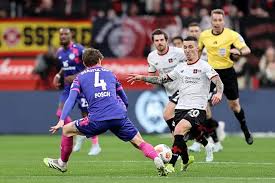
Relegation matches in the 2016/17 Bundesliga brought a different kind of pressure from title or top‑four races, with clubs like Ingolstadt, Darmstadt, Hamburg, Bremen and Wolfsburg fighting to avoid the drop and the relegation play‑off. That desperation changed how players tackled, how referees intervened and how often crucial penalty‑area incidents occurred, making yellow cards, red cards and penalties more central to betting decisions than in less consequential fixtures.
Why Relegation Pressure Increases Foul and Card Risk
Teams battling relegation often respond to pressure with higher defensive intensity—more aggressive duels, tactical fouls to stop counters, and emotional reactions to setbacks. Bundesliga statistics from 2016/17 show that clubs in or around the drop zone, including Hamburger SV and FC Ingolstadt, ranked among the leaders in fouls committed per match, with Hamburg averaging around 16 fouls and Ingolstadt over 15.5 across 34 games. That volume of infringements naturally raises the base rate of bookable offences, especially when repeated fouls, protests and time‑wasting are added late in tight matches.
At the same time, research on discipline suggests that players do adjust behaviour when suspension risk is high—for example, fouling less when one yellow card away from a ban—but relegation anxiety can override that caution in must‑not‑lose games. The result is a volatile mix: some individuals pull out of marginal challenges to avoid suspensions, while others over‑commit in dangerous zones, increasing both yellow and potential red‑card risk when tackles are late or last‑man.
How Red Cards Reshape Scoring in High-Stakes Games
Red cards have a quantifiable effect on scoring dynamics, and that effect interacts strongly with relegation context. A study of elite football matches found that a sending‑off changes scoring rates significantly, with an estimated impact of roughly 0.39 additional expected goals when the dismissed player belongs to the away team and about 0.50 when the player is from the home team if the red card occurs with around 30 minutes left. Playing a man down for that long damages the penalised team’s scoring prospects and improves the opponent’s, often turning tight relegation battles into open, chaotic finales.
In the 2016/17 Bundesliga, where every point near the bottom mattered, a single red card in a relegation six‑pointer could swing survival odds dramatically, potentially leading to more risk‑taking from the side chasing and calmer game management from the team benefiting from the numerical advantage. For bettors, that means red‑card probability is not just a side market; it directly shapes late‑game totals, correct scores and live handicaps in these fixtures.
Why Penalties Become More Likely in Relegation Battles
Penalties arise when defenders commit fouls or handle the ball inside their own penalty area, and both desperation and fatigue increase the likelihood of such mistakes. Under relegation pressure, defenders are more willing to dive into last‑ditch tackles, pull shirts or block shots with outstretched limbs, especially late in matches where a goal against could be catastrophic. At the same time, attackers know that referees are scrutinising penalty‑area challenges closely, which can encourage more direct dribbling into dangerous zones and more deliberate “attacking” of defenders’ legs and arms.
The basic disciplinary framework—direct free kicks, penalty kicks, yellow cards and red cards—does not change in these games, but the frequency of borderline incidents does. When you combine high foul counts from relegation‑threatened teams with the tendency of tight, late‑season matches to produce more penalty‑area scrambles, the conditional probability of a penalty being awarded in at least one of these fixtures rises compared with many mid‑table, low‑stakes games.
A Structured View: Relegation Games and Discipline Patterns
A simple table helps to link the characteristics of 2016/17 relegation battles to expected card and penalty risk.
| Match scenario in relegation fight | Typical on-pitch behaviour | Card / penalty expectation |
| Tight scoreline, late in season | Tactical fouls, time-wasting, protest, nervous clearances | Elevated yellows, higher chance of late penalty incident |
| Early goal against for threatened team | Desperate pressing, risky tackles, stretched transitions | More fouls, higher red‑card risk on last‑man challenges |
| Goalless six-pointer with cautious tactics | Fewer open-play shots, many set pieces and duels | Moderate yellows, penalties mainly from set‑piece chaos |
In 2016/17, matches involving sides like Hamburg, Ingolstadt, Darmstadt and Wolfsburg in the run‑in often rotated through these scenarios as early goals, table permutations and other results on the day shifted incentives. For bettors, the key was to identify which scenario a particular match was likely to start in—and how game state could shift it—before treating cards or penalty bets as attractive.
Integrating Card and Penalty Angles into a Betting Platform Routine
Because relegation fixtures sit under heavy emotional and media focus, how you interface with operators matters. If you begin by browsing featured markets, you risk being drawn into headline bets—“team to stay up,” match winner—without structuring your view on cards and penalties. A more precise routine starts elsewhere: you first look at team‑level foul and card stats, pressure context (points needed to survive, remaining fixtures) and the likely referee’s general card‑awarding behaviour.
Only after forming a view about foul intensity and penalty‑area risk should you open your operator. In that workflow, your betting infrastructure becomes the final tool rather than the source of ideas. For instance, once you conclude that a specific 2016/17 relegation clash is structurally primed for more fouls and potential penalty‑area incidents—given two highly aggressive defences and a referee with a history of firm discipline—you might then log into a sports betting service such as member ufabet with a narrow objective: to compare available card and penalty lines against your expectations, rather than letting suggested accumulators pull you toward unrelated markets.
Where casino online Activity Can Obscure Discipline-Based Edges
Edges built on discipline patterns and relegation psychology are subtle and require careful tracking across a small number of matches. If winnings or losses from these bets are lumped into a broad stream of activity, you lose the ability to distinguish whether your card and penalty reading is genuinely adding value. To preserve that signal, some bettors treat relegation‑focused discipline bets as a discrete segment of their record and avoid mixing that bankroll with funds used for other forms of gambling on a casino online website, where outcomes are driven by different mechanisms entirely.
When Relegation Logic Fails: Over- and Underestimating Risk
Despite clear mechanisms, relegation narratives can mislead. One failure mode is assuming that every relegation six‑pointer is a “war” full of cards and penalties; in reality, some coaches respond to the stakes by instructing players to stay on their feet, avoid rash challenges and minimise risk of suspensions, producing fewer fouls than expected despite the table pressure. Another is ignoring referee personality: some officials maintain consistent, low card counts even under extreme pressure, while others respond more to stakes and crowd intensity, but many bettors treat all referees as interchangeable.
A third mistake is conflating fouls with cards and penalties. High foul counts do not automatically translate into more bookings or spot kicks if the infractions are mostly in non‑dangerous zones or if referees choose management through verbal warnings rather than sanctions. Without adjusting for foul location, match context and referee tendencies, it is easy to over‑bet high card or penalty lines based on raw foul numbers alone.
Summary
In the 2016/17 Bundesliga, relegation battles involving clubs like Ingolstadt, Darmstadt, Hamburg and Wolfsburg naturally fostered conditions for more frequent, and more consequential, fouls—raising the stakes on yellow cards, red cards and penalties. Studies on discipline and scoring show that red cards significantly alter expected goals, while persistent fouling and last‑ditch defending in the box increase the potential for spot kicks, especially in tight, late‑season matches where survival is on the line. For serious bettors, the most productive approach was to read these mechanisms in advance—through team foul stats, referee profiles and table context—and then selectively target card and penalty markets via a disciplined operator workflow, keeping these niche edges analytically separate from more general gambling so their true impact on long‑term results could be evaluated clearly.