


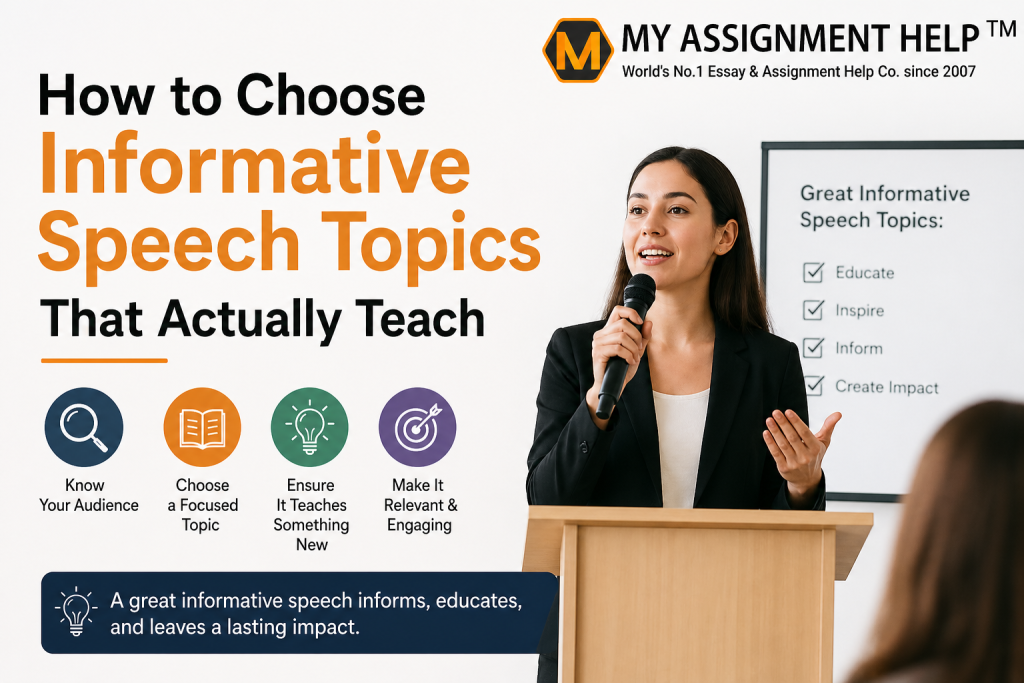
Public speaking is often misunderstood as simply standing behind a podium and talking. In reality, an informative speech is a teaching tool. Your goal isn’t just to be heard; it is to ensure that when you finish, your audience walks away with a new skill, a fresh perspective, or a deeper understanding of a complex subject. The difference between a speech that “drifts” and one that “delivers” usually starts long before you step on stage. It begins with the selection of a topic that is both narrow enough to cover in a few minutes and broad enough to be relevant to your listeners.
When you start your research, the sheer volume of options can be overwhelming. Many students find success by looking through curated lists of the Best Informative Speech Topics to see what sparks their curiosity. If the pressure of finding the right angle feels too much, reaching out for guidance from a platform such as MyAssignmenthelp can provide the necessary structure to your thoughts. A well-chosen topic serves as the skeleton of your presentation; if the bones are strong, the rest of the speech will naturally fall into place.
1. Identify Your Audience’s Knowledge Gap
The first rule of teaching is knowing who you are talking to. If you speak about something everyone already knows, you aren’t teaching—you are just repeating. If you speak about something too advanced, you will lose them in the first minute.
Analyze Their Background
Are you speaking to fellow students, industry experts, or a general community group? A room full of biology majors will want a deep dive into CRISPR technology, while a general audience might prefer an informative talk on how to start a backyard vegetable garden.
Find the “Sweet Spot”
The best topics sit right in the middle of “unfamiliar” and “relatable.” You want to take a subject that people have heard of but don’t fully understand. This creates instant curiosity, as people are naturally drawn to filling in the gaps in their own knowledge.
2. Focus on “The Why” and “The How”
Informative speeches usually fall into three categories: explaining a process, describing an event, or clarifying a concept. To truly “teach,” you need to move beyond just listing facts.
Process-Oriented Topics
These are essentially “how-to” guides. Instead of just saying what something is, show the audience how it works. For example, instead of a speech on “Coffee,” try “The Science of the Perfect Pour-Over: How Chemistry Affects Flavor.”
Concept-Oriented Topics
These deal with abstract ideas like “The Psychology of Procrastination” or “How Inflation Actually Works.” To make these stick, you must use analogies. Comparing inflation to a shrinking chocolate bar makes a complex economic theory instantly understandable.
3. Narrow the Scope for Maximum Impact
One of the biggest mistakes speakers make is choosing a topic that is way too big. You cannot explain “The History of Warfare” in five minutes. You can, however, explain “How the Invention of the Longbow Changed Medieval Battles.”
The Funnel Method
Start with a broad interest and keep narrowing it down until you hit a specific point of impact.
- Broad: Space
- Narrower: Mars
- Specific: The Challenges of Growing Food in Martian Soil.
Quality Over Quantity
It is much better to teach one small thing perfectly than to mention ten big things vaguely. When students struggle to trim the fat from their drafts, utilizing a professional speech writing service can be incredibly helpful. These experts know how to tighten a script so that every sentence serves a purpose. This ensures the audience stays focused on the core lesson without getting bogged down in unnecessary details.
4. Use Visual Aids to Support Learning
An informative speech is a visual experience as much as an auditory one. People retain about 10% of what they hear, but nearly 50% of what they see and hear together.
Simplicity in Slides
If you use slides, keep them clean. One image and three words are often more powerful than a paragraph of text. Your slides should support your words, not replace them.
The Power of Demonstration
If your topic allows for it, bring a physical object. If you are teaching about ancient coins, holding one up makes the history feel real and tangible.
5. Structure for Retention
A teacher’s best friend is a clear structure. If the audience knows where you are going, they are more likely to follow you there.
The Chronological Approach
This works best for history or process speeches. Start at the beginning and move forward in time. This is the most natural way for the human brain to process a story.
The Topical Approach
Break your subject into three distinct pillars. For a speech on “The Benefits of Meditation,” your pillars might be: 1. Physical health, 2. Emotional balance, and 3. Mental clarity. This “Rule of Three” makes the information much easier for the audience to remember later.
Author Bio
Jack Thomas is a Senior Academic Consultant at MyAssignmenthelp. He has spent over a decade helping students and professionals bridge the gap between complex data and engaging storytelling. Jack is an advocate for clear communication and believes that anyone can be a great teacher with the right preparation and a passion for their subject.
Frequently Asked Questions (FAQs)
1. What makes a speech “informative” rather than “persuasive”?
An informative speech aims to educate and provide facts without trying to change the audience’s mind or call them to action. You are the teacher, not the salesperson.
2. How do I know if my topic is too broad?
If you find yourself skipping over major details just to finish on time, your topic is too big. Try to focus on just one specific sub-section of that topic.
3. Can I use humor in an informative speech?
Yes! Humor is a great tool for keeping the audience engaged. Just make sure the jokes support the information rather than distracting from it.
4. How many main points should I have?
For most speeches under 10 minutes, three main points is the gold standard. It’s enough to be thorough but not so much that the audience gets overwhelmed.
5. How do I start an informative speech?Start with a “hook.” This could be a surprising statistic, a provocative question, or a short, relevant story that makes the audience realize they need to hear what you have to say.